
Short answer: most NZ farm gates are hot-dip galvanised steel sold in whole-foot lengths, and 12 ft (3.66 m) and 14 ft (4.27 m) are the common sizes, about 1 m high. Whether a gate lasts comes down to the post it hangs on more than the gate. A pedestrian gate starts from around $600 installed. Driveway and farm gates are priced on site, because the posts, the ground and the width set the cost.
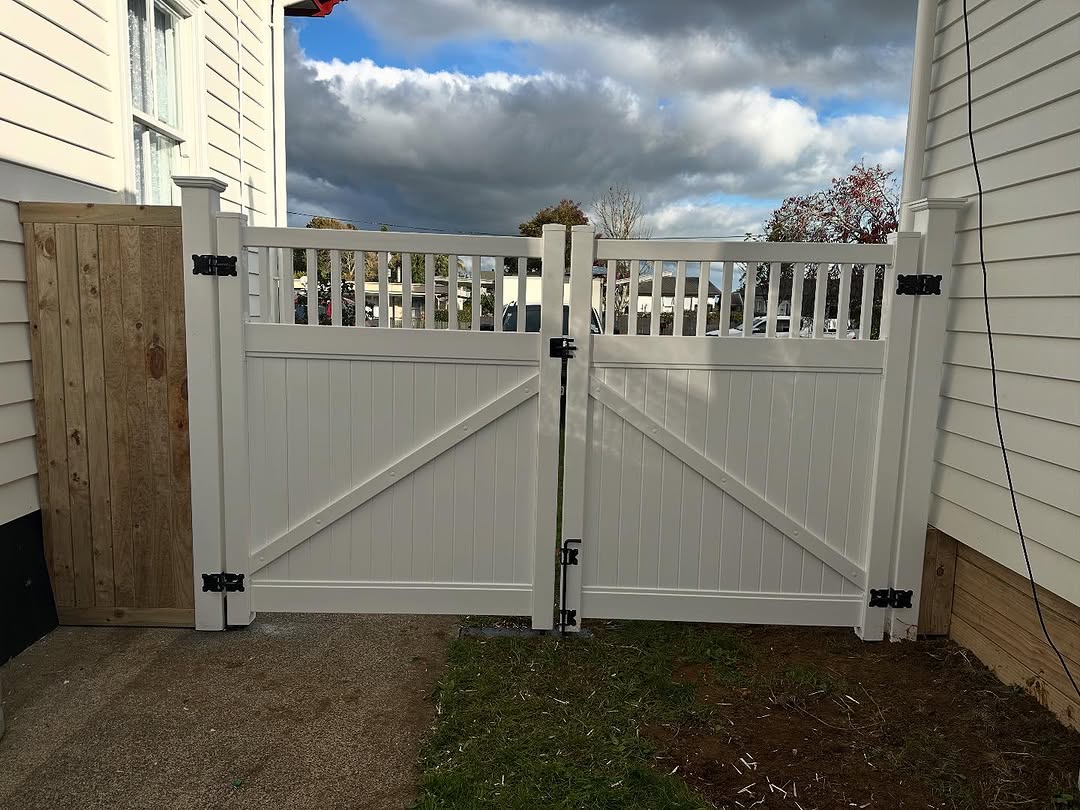
A double gate we put in to close off a back yard. Two leaves instead of one wide one, strap hinges on solid posts, a drop bolt in the middle, and the leftover gap filled in timber.
The gate in that photo has three details that matter on any gate, whatever it's made of. Each leaf hangs on its own post. The two leaves meet in the middle, where a drop bolt holds the fixed leaf to the ground. And each leaf carries a diagonal brace that runs from the bottom hinge corner up to the top latch corner, so the weight goes back into the hinge post and the gate doesn't drop at the latch end. If a gate gets those three things wrong, it'll sag whatever you paid for it.
Farm gate sizes in NZ
NZ farm gates are made in feet and labelled in both units. The common lengths across the main brands (Gallagher, Hayes, Pel and the rural store house brands) are:
| Gate length | Metric | Typical use |
|---|---|---|
| 10 ft | 3.05 m | Yards, races, narrow gateways |
| 12 ft | 3.66 m | Standard paddock gateway, ute and quad access |
| 14 ft | 4.27 m | Tractor and trailer access, the most-stocked size |
| 16 ft | 4.88 m | Wide machinery, trucks, main entrances |
Heights run from about 1.0 m to 1.05 m for standard field gates. Heavier versions of each length are available for cattle and high-traffic gateways, and lighter "economy" gates suit sheep and light stock pressure. Some in-between lengths, such as 13 ft and 15 ft, are made to order.
Measure post to post, not gate length. The gate is shorter than the gap it hangs in, to leave room for the hinges and latch. Te Pari, for example, says to add about 80 mm to the gate length to get the post-to-post opening. If you're setting new posts, buy the gate first and set the posts to suit it. Don't set the posts and then go looking for a gate to fit.
Go one size wider than you think. A gateway sized for the ute will be too tight for the contractor's tractor and baler, or for a stock truck turning in off the road. Widening a gateway later means pulling a post that was set to stay put.
Driveway gate materials
On a house section the gate has to look right as well as work, so the choice is wider:
| Material | Look | Upkeep | Suits |
|---|---|---|---|
| Timber (treated pine, macrocarpa, hardwood) | Matches a timber fence, can be built to any width | Stain or paint every few years; check the brace and hinges | Matching an existing paling or slat fence |
| Aluminium | Clean, modern, powder-coated colour | Low; wash it down | Front boundaries, pool areas, coastal sites |
| PVC / vinyl | White picket or solid-panel look | Low; no painting | Side and back yard access, villas and weatherboard homes |
| Galvanised steel | Farm gate look | Very low | Lifestyle blocks, long rural driveways |
Single or double? A single wide leaf puts all its weight on one hinge post and needs a big clear swing area. Splitting the opening into two leaves halves the swing and the load on each post, which is why the gate at the top of this page is a pair. The trade-off is a centre drop bolt and a socket set in the ground, and both have to line up.
Sliding gates suit steep driveways and sites with no room to swing a gate. They need a straight run of fence alongside for the gate to slide past. Most are motorised, and an automated gate needs an electrician and an automation installer as well as a builder.
Why gates sag (and how to stop it)
A sagging gate almost always comes down to one of these:
- The hinge post has moved. A long gate acts as a lever on its hinge post. If the post is undersized, too shallow, or set in soft ground, it leans, and the gate drops at the latch end.
- The hanging post is doing two jobs. A gate post shouldn't also be the strainer for a wire or rail fence. Fence tension pulls one way and the gate's weight the other, and the post loses. Give the gate its own post.
- The brace runs the wrong way. On a timber gate the diagonal has to run from the bottom of the hinge side up to the top of the latch side. Fitted the other way round, it lets the gate rack.
- The hinges are too light for the weight of the gate, or the bolts have worked loose.
The fix is a bigger post set deeper. As a rule of thumb, a hanging post for a 12–14 ft farm gate should be noticeably heavier than your line posts, something in the 175–200 mm range, and set at least 900 mm into the ground, deeper in soft or wet soil. On a house section, a timber or aluminium driveway gate wants a solid post concreted in, not a fence post with heavier hinges screwed on.
Hanging a gate properly
What to check before a gate goes up:
- Swing direction. Hang it to swing into your property, not out over the footpath or road. On a farm, make sure it swings the way the stock will be moving.
- Slope. On sloping ground, a gate that swings uphill hits the ground partway open. Either swing it downhill, raise the hinge height, or use rising hinges.
- Hinge positions. Mark the hinge or gudgeon holes from the gate's own lug heights, and offset them far enough that the gate can open flat back against the fence.
- Clearance underneath. Leave enough gap for the ground to rise a little over winter, but not so much that lambs, dogs or chickens go under.
- Latch side. Set the latch post so it doesn't get pushed out of line every time the gate shuts against it. A stop or a separate latch post saves the hinge post from taking the hit.
- Drop bolt socket on double gates, set in concrete so it doesn't fill with dirt or move.
Gates in a working yard
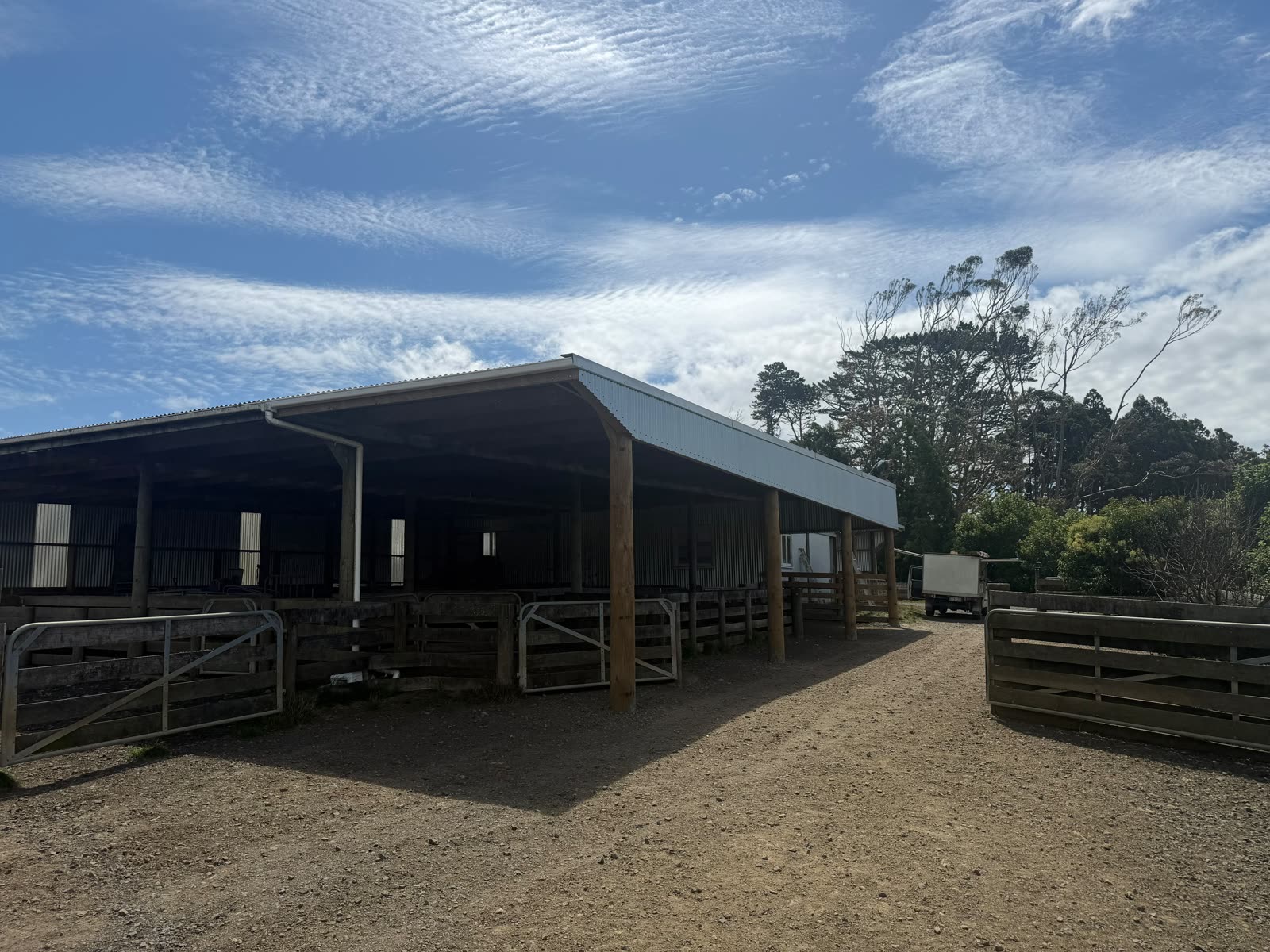
The covered yard extension we helped MCP Builders with. Galvanised gates hang between heavy timber posts in timber-railed yards, and every gate has a post big enough to carry it.
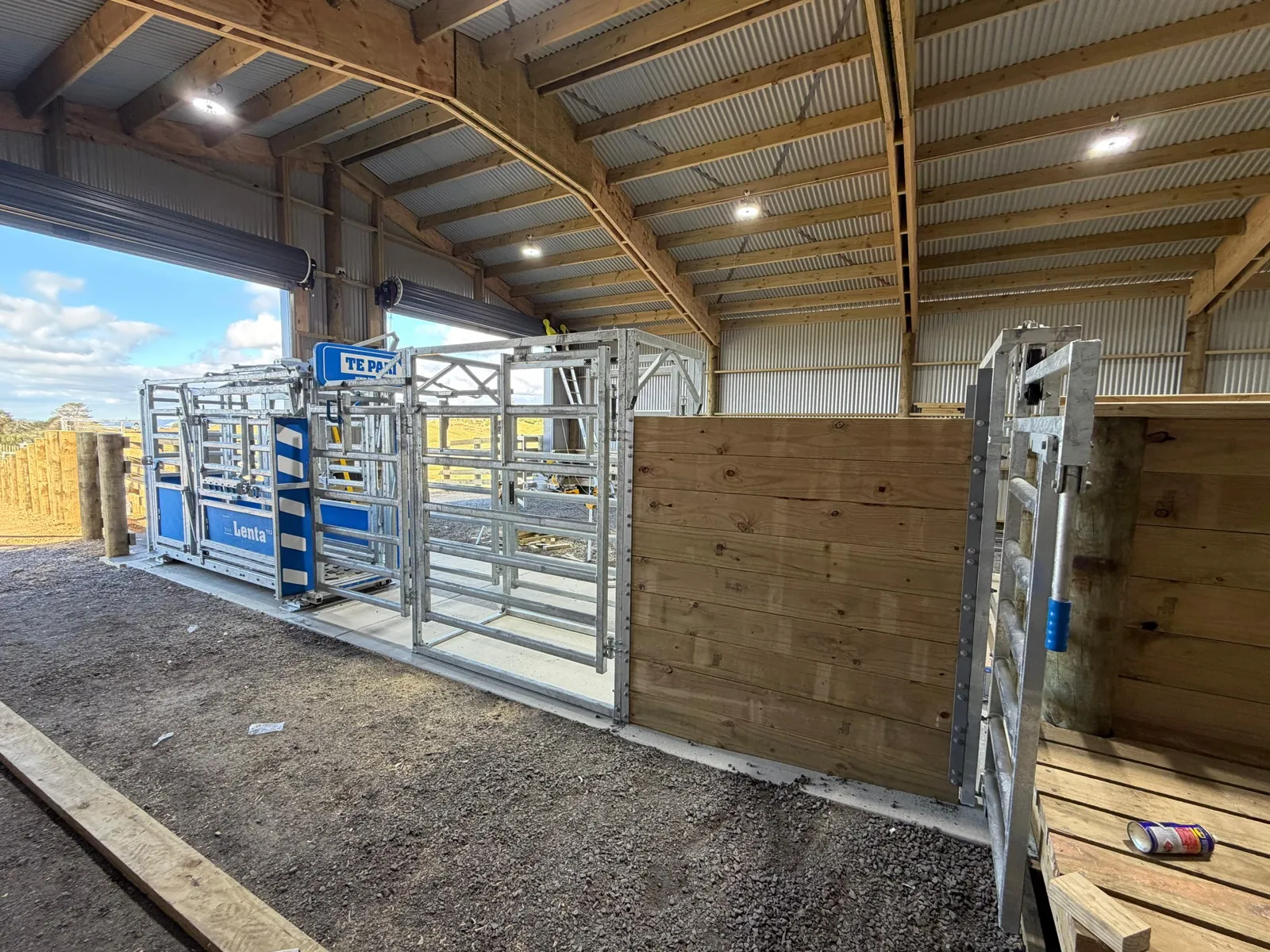
Inside the 20 × 13 m pole shed in Whiriwhiri, Waiuku. Steel gates and a crush sit inside solid timber walls. Cattle lean on everything, so posts and fixings are sized for that.
In stock yards the gates take far more load than a paddock gateway does: cattle push on them and lean on them all day. That's why yard gates are almost always heavy galvanised steel on big timber posts. It's the same post-first approach as above, with less room for error. More on that job in our pole shed build guide.
What a gate costs to install
There's no fixed price list for gates, because the gate is often the cheaper part of the job. As a guide:
- Pedestrian gate (timber or aluminium, on a residential fence): from around $600 installed, GST included.
- Driveway gate: quoted on site.
- Farm gate: quoted on site. You can buy the gate yourself from a rural supplier and have us set the posts and hang it.
What moves the price on driveway and farm gates:
- New posts or existing ones. Digging out an old rotten post and setting a new hanging post is most of the labour.
- Ground. Clay, rock, wet ground and slopes all add time.
- Width and weight. A 16 ft gate or a heavy timber driveway pair needs bigger posts and hinges.
- Single vs double, plus the drop bolt and socket.
- Concrete pad or mowing strip under the gate, if you want one.
- Tying into an existing fence, especially if the fence line has to be re-strained.
If the gate is part of a new fence, the gate is priced in with the fence. See our fence cost per metre guide for those figures.
Do you need a building consent for a gate?
Usually not. Fences and gates up to 2.5 m high are exempt from building consent under Exemption 21 of Schedule 1 of the Building Act. Height is measured from the top of the structure to the ground directly below it. See MBIE's guidance on fences and hoardings. Other common exemptions, from decks to sheds, are in our building consent exemptions guide.
Three things to check anyway:
- Pool gates are outside that exemption. A gate in a pool barrier needs a building consent and has to meet the pool barrier rules, including self-closing and self-latching.
- The district plan can limit fence and gate height on a road boundary, often from around 2 m, even where no building consent is needed.
- Boundary gates between neighbours fall under the Fencing Act 1978, so talk to the neighbour before you change a shared fence line.
Related Articles
- Fence Cost Per Metre NZ: Timber, Aluminium & Colorsteel
- Pole Shed Builder Waiuku & Franklin: 20×13m Build Guide
- Retaining Wall NZ: Timber Cost, Design & Consent (2026)
Get a gate sorted
Got a gate that drags, a gateway that's too narrow, or a new driveway that needs closing off? Send me a photo of the opening and a rough width, and tell me whether the posts are staying or going. I'll tell you straight what it needs.
WhatsApp me at +64 27 951 5272, or request a free on-site quote in Franklin, Pukekohe, Papakura and Waiuku.